Daniel 3:1-7: Persuasion, Pressure, and Praise: Lessons from Daniel's Symphony
Our storyline picks up sometime after Daniel interprets King Nebuchadnezzar's dream. Nebuchadnezzar gives God, and Daniel, real praise and honor. But it doesn't last.
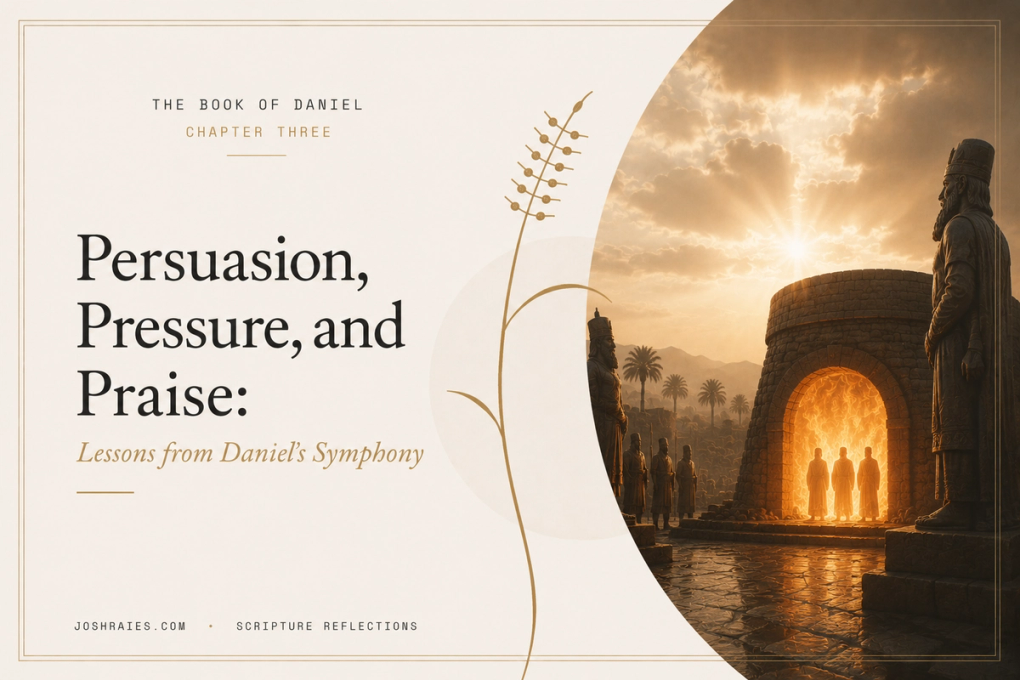
Chapter 3 opens with Nebuchadnezzar erecting a golden image for himself, ninety feet tall, on the plain of Dura in the province of Babylon. He picks the spot on purpose. It's a place built to hold a massive crowd. And he doesn't leave the response to chance. He commands it. Whenever the music sounds, every person in the crowd is to fall down and worship the image he's set up. The project has just been finished, and Nebuchadnezzar wants to commemorate it. So he summons every powerful, important, and influential person in his kingdom to that plain, to that image.
It's easy to read past this part and jump straight to the story we all know, the one about three men, soon to be four, standing in the fire. But I don't think we should skip what comes before it. Specifically, I think we need to sit with one detail: the music.
In chapter 3, a list of instruments gets repeated across the chapter. I'll be honest, in years past I read that list and pictured a chaotic gaggle of noise. But the more I've studied it, the more I've understood this wasn't noise at all. It was a symphony. An orchestra, playing something melodic, something compelling. Nebuchadnezzar knew exactly what he was doing. He didn't just want obedience by decree. He wanted to move people through persuasion, through their emotions, toward worshiping something less than God.
Put that way, it doesn't take long to see how close our situation is to the one these Hebrew boys faced in exile, in Nebuchadnezzar's Babylon. We don't have a ninety-foot golden statue. We don't have an audible symphony. But every one of us has something that functions the same way. The statue. The music.
Take political affiliation, right, left, or anywhere in between. These institutions command allegiance. And they play their own symphony, through media and every other channel available to them. It isn't melodic, not in the musical sense. But it is emotional. Think about the stories each side leans on to move its own people: the martyrdom of certain figures, the injustice done to certain groups. These earthly powers run the same playbook Nebuchadnezzar ran. And it works. It's compelling.
The repetition of that orchestra through Daniel 3 is worth paying attention to in our own lives, because compromise isn't a one-time decision. It's something we face often, if not daily. We will hear the music. And we will have to decide, again and again, whether we bow to the institutions of men or stay faithful to the kingdom of heaven.
Be wary. Faithfulness costs us now. Compromise costs us forever.