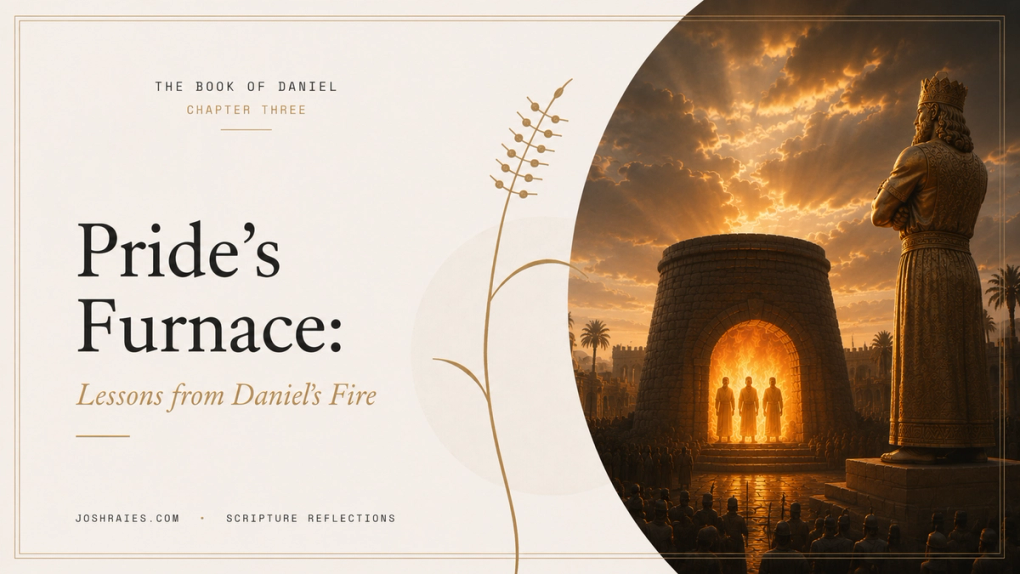
Daniel 3:19-30: Pride's Furnace: Lessons from Daniel's Fire
Daniel 3:19–30. Nebuchadnezzar is furious. Shadrach, Meshach, and Abednego have just told him plainly that they will not bow to the golden image he erected, and they will not worship his gods. His response is irrational. He doesn't just carry out the punishment he had already announced for failing to obey the law he himself put in place. He takes it to an extreme that serves no purpose. He commands that the furnace be heated seven times hotter than usual. I don't know exactly how hot that is, but it's hotter than we can really comprehend, given that the men who threw Shadrach, Meshach, and Abednego into the fire were killed simply by how close they had to stand to the opening of the furnace. That's how hot it was. And that's completely unnecessary if the goal is only to punish three insubordinate officials.
We could spend this whole passage on the importance of God's presence in the fire. But what struck me most as I sat with this chapter was Nebuchadnezzar's pride. It's really the main character of this passage. Because there is no explaining his response, his actions, apart from the fact that his pride was wounded. And if you dissect that wound, a couple pieces are essential to understanding why it cut so deep.
The first is that the rejection was public. Shadrach, Meshach, and Abednego did not object to Nebuchadnezzar in private. The Chaldeans had brought the accusation forward publicly, and now these three men stood before the king, in front of the rulers, authorities, and influential men of Babylon, and said, we will not bow to your image, and we will not worship your gods. For that rejection to happen in front of that crowd trivialized Nebuchadnezzar's power. It diminished it. His first response, in my opinion, was rooted in insecurity. He realized his power could be shaken. It was not absolute.
The second piece is that he had elevated these men. It's obvious Nebuchadnezzar thought of himself as something like a god, the one who moves and shakes the world, who puts people in positions of power and authority, who punishes the wicked. And now these men he had elevated appeared to be betraying him. Betrayal is painful for anyone. But for Nebuchadnezzar it was more than pain. It was, how dare they repay my kindness with betrayal. There is no gray area for him. In his mind there is no option but to be honored as worthy, which requires absolute loyalty and allegiance. When he doesn't get that, he acts out.
There's probably more we could say about why Nebuchadnezzar's pride was wounded here, but I want us to take some real takeaways about what pride does, both to us and in the way we interact with the world, as we keep thinking about what it means to live as exiles. Maybe it's the moment someone challenges you in front of others, and what rises up in you isn't the desire to be right, it's the refusal to be seen losing. Maybe it's the person you've poured into who disappoints you, and instead of grace you reach for scorched earth. Nebuchadnezzar's furnace is an extreme case, but the instinct behind it isn't foreign to us.
The first thing to know is that pride poisons perception. Nebuchadnezzar couldn't see clearly. That's the language used to describe his fury. His face was distorted with rage. And when you can't see clearly, you can't make good decisions. You can't think, these are people of value, and this command is arbitrary, even if it is law. Nebuchadnezzar was above the law. He made the law. And yet his pride made him a slave to his own command. Left unchecked, pride keeps us from seeing the world around us clearly.
The second thing is that pride paralyzes prudence. Nebuchadnezzar could not receive this rejection with a clear mind, and then he acted against it with complete irrationality. Heating a furnace seven times hotter than normal makes no sense. What does that accomplish? It isn't more efficient. Nebuchadnezzar's pride took away his ability to act with wisdom and discernment. His actions were those of a man mastered by rage, not a king exercising wisdom.
And lastly, pride plows over people. To Nebuchadnezzar it didn't matter what collateral damage there was in seeking vengeance for the slight against his pride. The text simply describes mighty men from his own army as the victims of his lack of perception and prudence. They were killed on account of his petty, wounded pride.
More than these three alliterations, I think it's worth pausing to consider the ways pride could be rearing its head in our own lives in ways similar to Nebuchadnezzar's. And it's worth noticing what happens next in the story. Nebuchadnezzar's pride was so wounded that he tried to kill three men over a public rejection. But when he looked into the fire, he saw four men walking, unbound, unharmed, and the fourth, in his own pagan words, looked like "a son of the gods." The very thing his pride feared, being diminished in front of the rulers and officials of his own kingdom, became the moment he stood up in front of all of them and blessed the God of Shadrach, Meshach, and Abednego. Pride tried to destroy three faithful men. God used it to put himself on display.
That fourth man in the furnace is worth sitting with. Nebuchadnezzar didn't have the categories to know what he was looking at, but I believe he was looking at Christ. Before Bethlehem, before the incarnation, the Son of God was already in the business of walking with his people through fire. It's important, as we consider our own pride, that we take note of God's presence with his people as they are wronged because of the pride of man. Because Jesus stepped into the fire himself, we can be confident we will never be left, and we will never be forsaken. That is hope in the midst of pride's furnace.