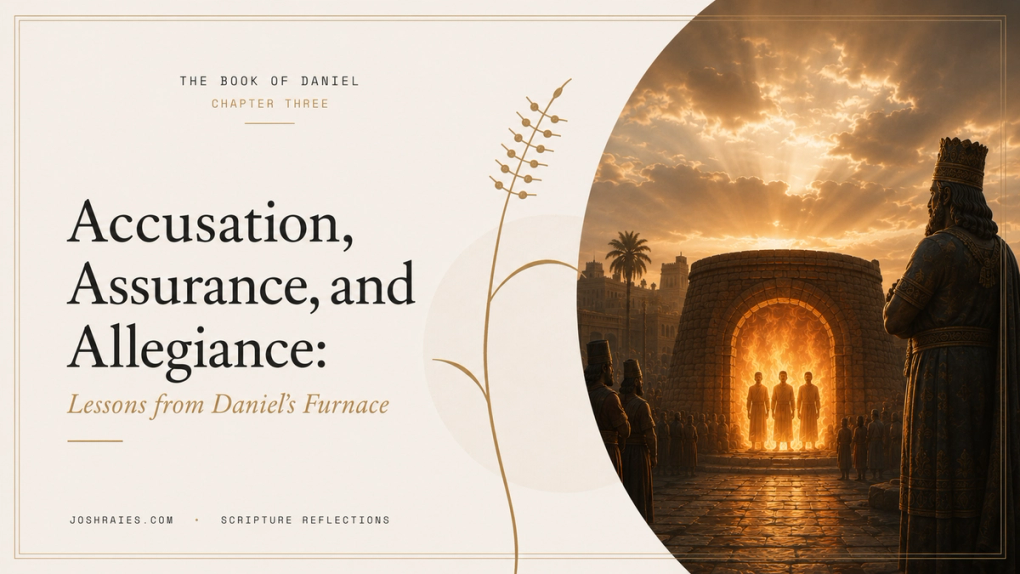
Daniel 3:8-18: Accusation, Assurance, and Allegiance: Lessons from Daniel's Furnace
The story continues. Nebuchadnezzar has given his command: everyone bows down and worships the golden image at the sound of the music. And for a while, everything seems fine. Until a group called the Chaldeans comes to the king with news. Shadrach, Meshach, and Abednego — the Hebrew officials Daniel had placed over the province — refuse to serve Nebuchadnezzar's gods or worship his image.
I did some digging on who these Chaldeans were. They were part of the priestly class in the Babylonian Empire. And when the ESV says they brought an accusation against the Hebrews, that word carries slanderous, malicious intent. It's not a neutral report. It's an attack.
That detail is worth sitting with, because there's something here about life in exile. It's not just that we're foreigners in a strange land, trying to walk in obedience to God while still living under the laws and customs of the country we find ourselves in. It's that when we actually pursue a God-honoring life, we should expect accusers. People who want to harm us precisely because of the good we do, and because of the blessing and provision God has put on our lives. That's exactly what the Chaldeans were doing to the Hebrews.
Nebuchadnezzar responds in fury. His pride is clearly driving him. He has the three brought before him and questions them himself. I don't think it's a stretch to read some partiality into this moment. Daniel had brought Nebuchadnezzar real relief earlier, through the interpretation of his dream. And here, instead of executing these three on the spot, Nebuchadnezzar gives them a chance to explain themselves, and a second opportunity, at the sound of the music, to bow down and worship the image.
But even with that second chance, this second opportunity to compromise their faith and their convictions, the three don't budge. They stand there. This is where I think we gain the most from this passage: watching how they respond to the question. When Nebuchadnezzar lays out the choice again, bow down or burn, Shadrach, Meshach, and Abednego don't flinch. They don't ask for time to think it over. They don't negotiate. Their answer is immediate, because their allegiance was already settled, long before Nebuchadnezzar ever asked the question.
That's where their confidence comes from. And I don't think it's confidence built from experience, like an athlete who's been in the big moment before and knows what to expect. It's theological confidence. It's rooted in knowing who God is, how he works, what he does. Because of who they know God to be, they can act the way they do. They tell Nebuchadnezzar their God is able to save them. They say it with full faith. But they don't stop there. They also say that if God doesn't save them, he is no less worthy of their wholehearted worship.
That's probably the greatest takeaway from this passage: their conviction that obedience and faithfulness can't be contingent on the outcome we want. We don't know what shape God's greatness will take. He can be just as great in the faithful martyrdom of his saints as he is in a miraculous rescue from the fire. His glory isn't diminished either way. And neither is our good.
It was that belief that let Shadrach, Meshach, and Abednego stand resolute in front of the most powerful king on earth. They were fearless, because as they stood before Nebuchadnezzar, they were, in their actions, kneeling before the King of the universe.
So today, when you're faced with the decision to follow God based only on what he can do for you right now, think instead about what he's already done, at the cross. If we measure greatness the way Jesus defined it, through sacrifice, through loss, through death, we'll see God's greatness rightly, whatever outcome we end up facing.