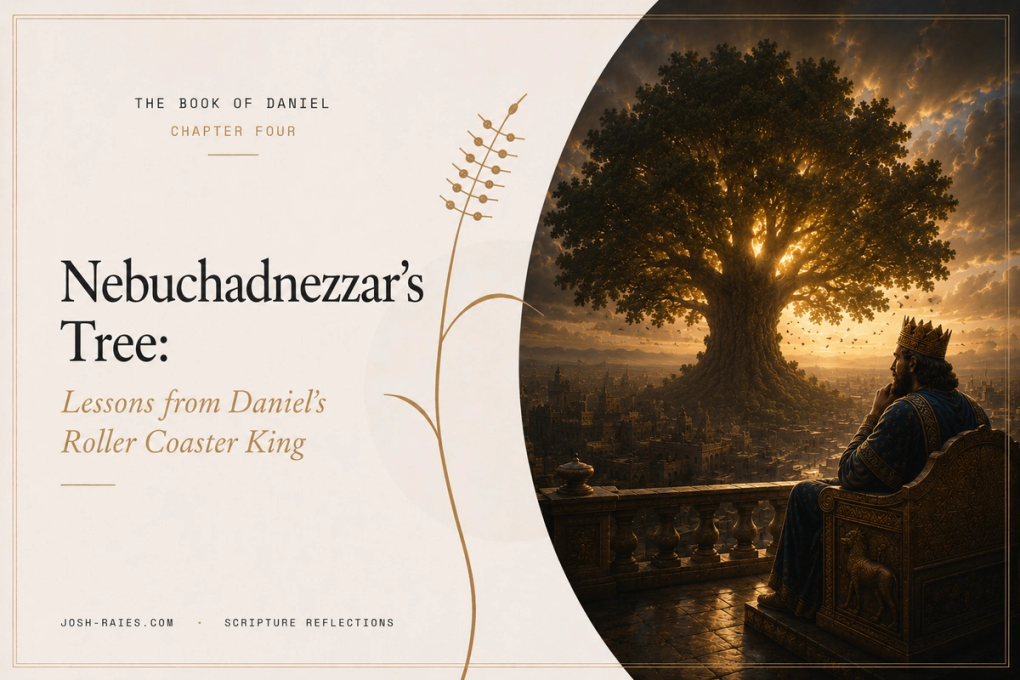
Daniel 4:1-18: Nebuchadnezzar's Tree: Lessons from Daniel's Roller Coaster King
Daniel 4:1-18 continues the story of Nebuchadnezzar, and his is a roller coaster of a character. He fluctuates between the highs of giving God — the God of Daniel, Shadrach, Meshach, and Abednego — some sense of esteem, honor, and praise, and the lows of walking in his own pride and hubris.
Following the account of the miraculous saving of Shadrach, Meshach, and Abednego, we find King Nebuchadnezzar back to his old ways. The text says he is at ease — settled, no longer wrestling with what God had just shown him through their deliverance. It makes me think of how often we experience great spiritual highs in our own lives. We're motivated, on fire, passionate about what God has done and who he is. And yet when everything calms down, we tend to drift back into patterns where we stop paying attention to God. For Nebuchadnezzar, that ease wasn't rest in God. It was complacency in his own power and position.
That's where Nebuchadnezzar is when God gives him another vision, another dream. And that ease quickly turns into fear. In his fear, he looks for answers. What's baffling to me is that even though he's been through this whole process before, it's obvious he didn't learn anything — which is another hallmark of pride: a lack of teachability. Even the hardest lessons don't get through. So in response to a dream he has zero ability to interpret, he calls on his magicians and wise men. Again they're unable to do the job, and so he says to himself, I'm going to call Daniel. No idea why he didn't start there.
He tells Daniel his dream. There was a tree that rose high into the heavens and bore great fruit, cast shade for the animals to lie under, and its branches were plentiful for the birds to perch in. At some point a heavenly being comes and chops it down, lops off its branches, so that only a stump remains — bound with a band of iron and bronze, sitting in the grass among the animals. And this heavenly being announces something simple — something that should come without explanation, self-evident: that the living may know that the Most High rules the kingdom of men, gives it to whomever he will, and sets over it the lowliest of men.
This is where I want to go a little deeper and put most of our reflection. Daniel will get into what the dream actually means, the interpretation, in the next passage. But I think it's important to recognize what God is doing here and what it says about his character. Remember that Nebuchadnezzar's pride has been the recurring theme through the book of Daniel, and no matter how plentiful the opportunities to be humbled — to give God glory, credit, and honor — Nebuchadnezzar has not learned. So what does God do? He gives Nebuchadnezzar this dream, and in the dream explains himself. The purpose of the dream, what it communicates, is threefold. First, that those who are living may know that the Most High rules the kingdom of men. Think about who received this dream: the greatest ruler in the world, for all intents and purposes, at the time. God is revealing to him that he is not in charge. More than that, it is God himself who has given him his rule, his authority. And lastly, to top it off — who does God give it to, but the lowliest of men?
Now I don't think that last part, the lowliest of men, is necessarily descriptive of who it is God puts into positions of power relative to other men. It's obvious, as we look throughout history, that God often puts strong men, wise men, brilliant men into power — capable men, but as they stand before God, incapable, unwise, weak. All of this serves the express purpose of giving Nebuchadnezzar another chance at repentance, at humbling himself before God does it for him — which is remarkable to think about, because God has already given Nebuchadnezzar so many opportunities up to this point to do exactly that.
So ask yourself: what does this say about who God is? What does this say about his character? So often we think of the God of the Old Testament as one of wrath, judgment, and justice. Yet to the greatest pagan king, he shows inordinate restraint and mercy. He truly is a God of not only second, but third chances. This is wonderfully humbling and encouraging to me today, because I so often find myself identifying with Nebuchadnezzar — with my own pride, so often unable and unwilling to respond to God's merciful chances to humble myself.
What does it do to my heart to know that Nebuchadnezzar was extended this kind of mercy from God, even without the full revelation of Jesus Christ that I have? I stand before God with Christ as my mediator. What does that mean for God's mercy and kindness and graciousness toward me today, in my pride? May I have the strength to respond to God's first chance — to walk in humility by his power, and not have to walk through the pain of his humbling. Though we know that when it does come, it is good and necessary, because it's in that divine humbling that we become more like Jesus.