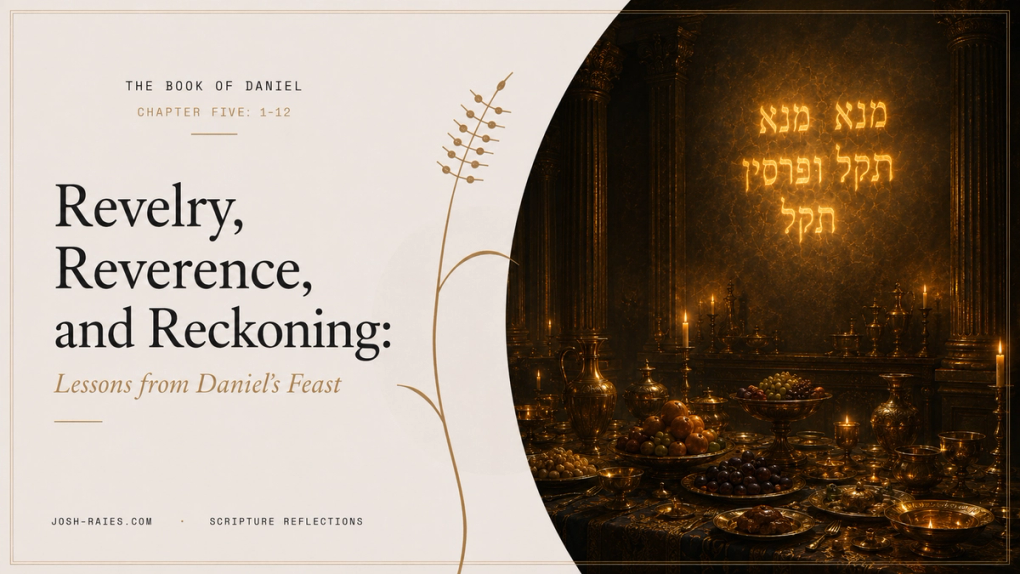
Daniel 5:1-12: Revelry, Reverence, and Reckoning: Lessons from Daniel's Feast
Daniel 5, verses 1 through 12. Some time has passed in the narrative of Daniel, and we're introduced to a new character. Nebuchadnezzar is no longer on the throne. Belshazzar reigns in his place — the text calls Nebuchadnezzar his father, though in the language of the ancient Near East that word often meant predecessor or ancestor rather than a direct father-son relationship. Either way, we aren't given much background on Belshazzar, but we quickly see everything we need to know about his character, because the first scene we get of him is a lavish party he throws for himself and his friends.
It's obvious there's a lack of reverence in the way Belshazzar carries himself, conducts himself, and rules his kingdom. When we contrast him with Nebuchadnezzar, the difference is stark. When Nebuchadnezzar gathered his royal subjects and his lords, it was for the sake of honor, dignity, worship, reverence. When Belshazzar gathers his, it's for the sake of debauchery.
One detail tells us plainly where Belshazzar's heart lies. Not only does he drink wine in front of all his lords and make himself drunk, but in the middle of the party he calls for the golden vessels taken from the temple in Jerusalem to be brought out, so they can drink from them. To the Hebrews, this is an abomination. Belshazzar doesn't care. He does it anyway. The vessels are brought forward, and they drink to their heart's content.
All the fun and fanfare come to a screeching halt when a hand appears on the wall of the great hall where they're celebrating. This is one of those stories that, especially if you grew up reading or hearing it, is easy to glaze over. But it's a genuinely miraculous moment, the first of its kind for Belshazzar, especially set against his father Nebuchadnezzar, who had multiple encounters where the divine and supernatural collided with the finite and physical. We should take a moment to recognize the weight of this scene. God is standing here. God is revealing himself, making himself known, in the middle of the greatest pagan kingdom on earth. He's glorified in this moment.
So the hand writes out this phrase on the wall, and Belshazzar is terrified. The description of his response to this divine intervention is so vivid, so descriptive, that the contrast between who he was before this moment and who he is after is unmistakable. He has, quite literally, seen the hand of God. He will never be the same.
Like his father before him, Belshazzar now seeks to understand what's happening, what this writing means. He calls for his wise men. We've heard this before, and just like before, they're unable to answer his question or interpret the writing. So the one truly wise person in the room speaks up — the queen, most likely the queen mother, since Belshazzar's wives are already at the feast. She's the one still carrying the institutional memory of his father's court, memory Belshazzar himself never bothered to inherit. She tells him there is a man in the kingdom who has the wisdom and knowledge and understanding of the divine — the man his father relied on, turned to. Why not ask him? Again and again in this story, God uses the voice of someone speaking reason and gentle correction into the moment. Belshazzar agrees and says, bring me this man. Whoever interprets this writing, I will give him great honor — a purple robe, a golden chain, all the trappings of royalty and majesty.
We'll get into what the writing on the wall actually means, and the sequence of events that follows, another time. For today, I think there are a few lessons we can take from Belshazzar and from this scene.
The first is this: Nebuchadnezzar ended his life, or at least a part of his story in Daniel, giving ultimate praise and glory to God after being repeatedly exposed to his divine power and ultimately humbled. And yet none of that — none of Nebuchadnezzar's experience with God — translated into the life of Belshazzar. If anything, it's the opposite. Belshazzar has no reverence for the God of Israel, no regard for him at all. What we can take from this is what the New Testament makes plain. Jesus tells Nicodemus, "That which is born of the flesh is flesh; and that which is born of the Spirit is spirit" (John 3:6). I am not saved because of the faith, the confession, the transformation, or the experience of my family. Who my family is has no bearing on who I am before God. Our familial history doesn't save us. Only a new birth does.
The second thing we can glean from Belshazzar's proclivity toward debauchery is that God is the one who puts kings in their places. That was a repeated theme in Nebuchadnezzar's life, and when God does this, it's with the expectation that they rule justly. There's an obligation that comes with the position. Not every ruler executes that role well — obviously. But from what we can see here, Belshazzar doesn't even attempt to. He seems far more concerned with fun, enjoyment, and merriment than with the state of his kingdom.
So, two things to take from Belshazzar: honor God, hold him in high regard. And whatever status or position he's given you, don't waste it on your own enjoyment. Leverage it for the sake of God's glory, for the advancement of his kingdom, and for the flourishing of the world around you.
The last thing I want to draw out of this passage, not just this scene but as we look back across the kings of Babylon, is this: it is the tendency and nature of man to rely on his own wisdom, and yet the wisdom of man means nothing to God. So in our perplexity, in our confusion, in our need for knowledge and understanding — do we turn to man for wisdom, or do we turn to God?